



If you grew up equating businesspeople with unrestrained greed, you might wonder if making a profit and doing the right thing are mutually exclusive. After all, businesses must charge more than their costs to make a profit. Is that taking advantage of the customer? And is investing in clean energy, paying a fair wage and supporting social causes too expensive?
The good news is you can make money and be a good corporate citizen. Practicing corporate social responsibility (CSR) is often a driver of positive effects on the bottom line.
The 2026 CSR Landscape: Trends You Need to Know
In 2026, corporate social responsibility is shifting from voluntary philanthropy to a strategic necessity regulated by data and consumer demand. Modern business owners must navigate a clearer set of expectations.
- The crackdown on greenwashing: Regulatory bodies and consumers are demanding proof, not just promises. The European Union and the U.S. Federal Trade Commission (FTC) have tightened guidelines on environmental marketing claims. Businesses must now back up terms like “eco-friendly” or “carbon neutral” with verified data to build trust and avoid penalties.
- AI ethics and governance: As artificial intelligence integrates into daily operations, ethical AI has become a pillar of CSR. Business leaders are responsible for ensuring their AI tools do not perpetuate bias in hiring or loaning and that they are transparent about data privacy.
- Diversity, Equity & Inclusion evolves: Despite headlines suggesting companies were rolling back DE&I initiatives, most companies remain committed to these efforts. However, expect 2026 an increasing focus on more measurable data to demonstrate the overall impact DE&I efforts have on companies — the success of these programs to create representative, equitable workforces will be judged by metrics, much like other business outcomes.
- Regulatory standardization: In March 2024, the SEC adopted climate disclosure rules requiring large public companies to report climate-related risks and greenhouse gas emissions; however, the agency stayed implementation pending legal challenges. Even private companies in global supply chains are increasingly being asked to report their emissions. Understanding your environmental data is quickly becoming a compliance consideration, not just a marketing bonus.
Can CSR increase company profits?
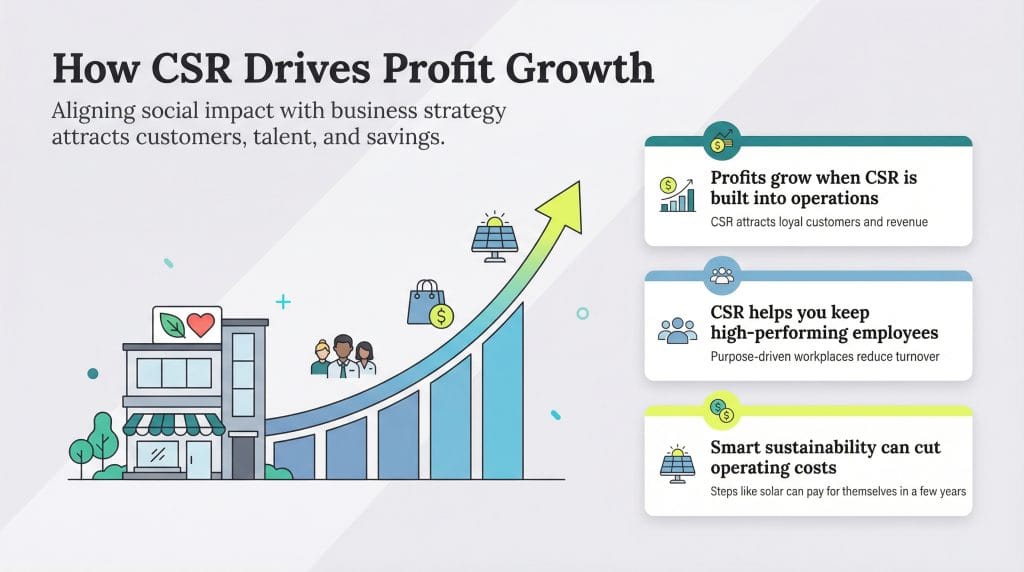
Companies that fully integrate CSR into their operations can still expect to achieve profitable growth and see sound financial returns on their investments. Companies committed to CSR can also reduce employee turnover because their practices appeal to high-level talent.
Companies can increase profits by incorporating CSR practices because many customers pay attention to how organizations react to social and political issues. Some may boycott companies with perceived negative values. Companies prioritizing CSR promote positive values, ultimately increasing customer traffic and company profit.
Additionally, some socially responsible practices actually cut business costs. For example, investing in energy-efficient LED lighting or smart thermostats can save businesses significant money on energy costs: the cost of installing these technologies is often recouped in three to five years.
“The businesses that thrive tomorrow will be those that solve society’s problems today,” noted Abdullah Choundhry, co-founder of Arbor, a B2B carbon accounting platform. “CSR isn’t about perfection — it’s about making each business decision with both profit and social impact in mind.”
What are the benefits of CSR for companies?

Businesses of all shapes, sizes and locations are adopting socially responsible policies — and for good reason. Consider the following benefits of implementing CSR practices and policies:
- CSR appeals to customers. Today’s consumer is socially conscious, and this awareness directly influences their purchasing decisions. If you’re not prioritizing responsible business practices, your customers won’t buy from you. “[CSR] activities afford companies the opportunity to deepen their relationships with customers and the community in which they operate, positively enhancing a company’s reputation for civic leadership in a way that reinforces its business strategies,” Skeet explained.
- Customers spend more with socially responsible companies. Customers are highly aware of local, national and global issues. These issues influence their buying decisions; they will buy more from companies showing concern. According to a 2023 report by NielsenIQ, 78 percent of U.S. consumers say a sustainable lifestyle is important to them. Additionally, products with ESG-related claims on packaging saw a 28 percent cumulative growth rate over five years, compared to 20 percent for products without such claims, proving a direct link between values and sales volume.
- CSR can improve your company’s public image. A positive reputation is priceless to businesses. Successful companies deliver high-quality products and services at a good value and provide excellent customer service and after-sales support. Adding involvement in civic causes can take a company’s public image to the next level. CSR shows consumers you care about your customers and the world. Companies that market green innovation initiatives enjoy positive media coverage, further strengthening their business reputation.
- CSR can attract investors. CSR can attract investors because potential stakeholders use a company’s social responsibility as part of the criteria for deciding whether or not to invest. According to Morgan Stanley’s 2025 Sustainable Signals report, 88 percent of individual investors reported they are interested in sustainable investing, and 59 percent said they plan to increase investments in sustainable businesses within the next year. CSR is also crucial for improving a company’s stock prices, which is essential for attracting investors.
- CSR can help your business attract and retain employees. A commitment to CSR can help you recruit and keep high-quality talent who want to work for an environmentally friendly company. In the 2025 Deloitte Gen Z and Millennial Survey, 89 percent of Gen Zs and 92 percent of millennials stated that having a sense of purpose is important to their overall job satisfaction and well-being. Furthermore, 40 percent of each generation say they have rejected assignments or employers based on their personal ethics or beliefs.
- CSR can help you streamline operations and reduce costs. Companies that focus on reducing waste save money. For example, moving from printing reports to digital reports helps companies save on paper and ink costs while reducing the trash they send to landfills. Upgrading to energy-efficient equipment and HVAC systems can save the company on utility bill costs, and using lighter-weight packaging saves money on shipping costs.
- CSR encourages innovation. Generating consumer goodwill and reducing emissions takes creativity and innovation. Companies implementing CSR practices may invest more in R&D or solicit customer feedback for eco-friendly ideas about new products, raw materials, services and processes. Additionally, when you invest in employee training and professional development, your team is more likely to devise innovative solutions to business problems.
How can small businesses practice CSR?
Small business owners may wonder about the costs of becoming more socially responsible and how shifting toward sustainability will affect their bottom line. Is it possible for a small business to be socially responsible while maintaining a healthy profit margin?
The short answer is yes. You can contribute without suffering economically. In fact, CSR initiatives can even save you money. For example, the U.S. Department of Energy states that properly using a programmable thermostat can save money on energy costs for a typical home, and similar principles apply to small business settings when combined with energy-efficient lighting and equipment upgrades.
Here are some tips for businesses adopting or strengthening their CSR practices:
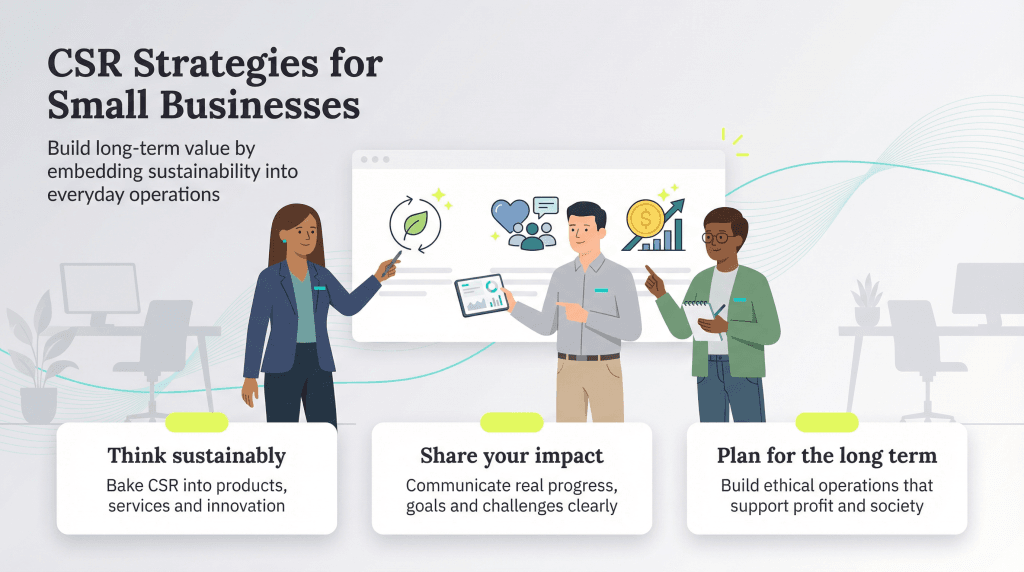
- Think sustainably when innovating. Small business owners should view innovation through the lens of sustainability. When creating new products, services or company initiatives, consider sustainability and how to appeal to socially conscious consumers.
- Share your sustainability efforts with customers. If you’re making CSR headway, communicate your efforts to customers. For example, socially conscious consumers often check a product’s packaging before purchasing. According to the NielsenIQ report, products with ESG-related claims saw a 28 percent higher cumulative growth rate than those without over a five-year period. So be sure to share your eco-conscious efforts with your customers.
- Have multiple CSR goals. While you may want to start with one CSR initiative, considering multiple socially responsible goals can be more helpful. The McKinsey/Nielsen report showed that products with multiple CSR claims have double the growth rate of those with only one claim. Customers tend to reward companies showing social responsibility is an important part of their culture by pursuing multiple areas of improvement.
- Think about the long term. Small businesses need not be overwhelmed by CSR and deferred financial returns. Begin thinking about the long term. If you demonstrate you care, consumers will shop with you repeatedly. CSR may not always deliver immediate financial returns but can foster long-term customer loyalty and sustainable growth.
- Lead with transparency. Choundhry emphasized the importance of being transparent when sharing your CSR efforts with employees and the public. “Don’t make exaggerated sustainability claims without tangible actions to back them up,” Choundhry cautioned. “If you claim your product is eco-friendly, ensure every aspect of its production and packaging supports that claim.” Being honest about your CSR challenges is also crucial. “Consumers value transparency and are more forgiving of companies that acknowledge their shortcomings while striving for improvement,” Choundhry added.
- Incorporate CSR into all aspects of operations. Amir Kahani, a business ethics expert at KeyIdeas, noted that abiding by ethical business practices is crucial to CSR success. “The solution lies in establishing ‘ethical businesses’ that incorporate responsibility into every aspect of [a business’] operations, not as a separate project but as their primary objective,” Kahani advised. “It would be best if you implemented a strategy that is a ‘win-win-win’ technique: win for the seller, win for the buyer, and win for society’s well-being.”
FAQs
No. Small businesses often have an advantage in CSR because they are more integrated into their local communities. Simple acts like sourcing locally, sponsoring local events or reducing office waste can build significant goodwill and customer loyalty without the overhead of massive corporate programs.
Corporate Social Responsibility (CSR) is a company’s internal framework for doing good and self-regulating. Environmental, Social, and Governance (ESG) is a set of measurable criteria that investors and lenders use to evaluate a company’s risk and sustainability performance. CSR is the “action,” while ESG is the “measurement” of that action.
To avoid greenwashing, ensure every claim you make is specific and backed by data. Avoid vague terms like “green” or “eco-friendly” without explanation. Instead, use specific language like “made from 80 percent recycled post-consumer waste” or “partnered with [Verified Charity Name].” Transparency about where you are still improving is often more trusted than claims of perfection
The Triple Bottom Line is a business concept that businesses should commit to measuring their social and environmental impact in addition to their financial performance, rather than solely focusing on generating profit. It is often summarized as “People, Planet and Profit.”
Measuring CSR ROI requires tracking both financial and non-financial metrics. Start by establishing baseline measurements before implementing initiatives, then track key performance indicators such as energy cost savings, employee turnover rates, customer acquisition costs, and brand sentiment scores. Financial returns might include reduced operational costs (like lower energy bills from efficiency upgrades), increased sales from sustainability-conscious consumers, or improved employee productivity. Non-financial returns include enhanced brand reputation, stronger stakeholder relationships, and risk mitigation.
Yes, CSR initiatives significantly impact employee retention, particularly among younger workers. The 2025 Deloitte Gen Z and Millennial Survey found that 89 percent of Gen Zs and 92 percent of millennials consider purpose important to job satisfaction, and approximately 40 percent of each generation have rejected assignments or employers based on personal ethics. Companies with strong CSR programs benefit from higher employee engagement, improved morale and increased loyalty. CSR also helps attract top talent, as job seekers increasingly evaluate potential employers’ values and sustainability commitments. To maximize retention benefits, ensure your CSR efforts align with employee values, communicate initiatives transparently, and provide opportunities for employees to participate directly in sustainability and social responsibility programs.
link